
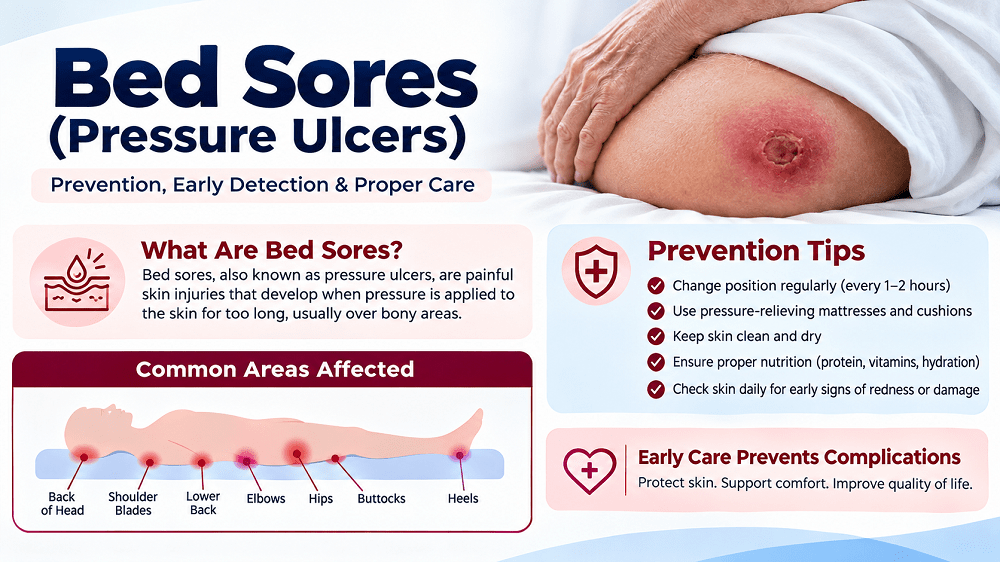
A bed sore, medically called a pressure ulcer or pressure injury, develops when prolonged pressure and shear cut off blood flow to the skin and the tissue underneath, most often over a bony area of the body. What starts as a patch of red, unbroken skin can, without the right care, progress into a deep wound reaching muscle or bone.
If you’re caring for someone who spends long periods in a bed or wheelchair, understanding what to look for, how these wounds are staged, and what actually helps prevent them can make a real difference. This guide walks through the causes, the clinical staging system, what each stage actually looks like, treatment approaches, and how to lower the risk in the first place.
What Causes a Pressure Ulcer?
Prolonged, unrelieved pressure compresses the small blood vessels in the skin and underlying tissue, cutting off the circulation that keeps that tissue alive. Left in place long enough, this leads to tissue damage and, eventually, a wound. Shear, which happens when layers of tissue slide against each other, such as when someone slowly slides down in a bed or reclined chair, compounds the damage by stretching and tearing the small blood vessels at an angle rather than just compressing them. Friction from skin rubbing against sheets or clothing adds further risk, particularly when combined with moisture.
A few factors make someone significantly more vulnerable to developing a pressure injury:
- Limited mobility. Anyone who can’t easily reposition themselves, whether from paralysis, severe illness, sedation, or general frailty, is at elevated risk, since the body’s natural instinct to shift weight away from discomfort doesn’t happen.
- Reduced sensation. Conditions like spinal cord injury or advanced neuropathy can mean a person doesn’t feel the early warning discomfort that would normally prompt them to move, allowing pressure to persist unnoticed.
- Poor nutrition. Inadequate protein and calorie intake weakens skin integrity and slows the body’s ability to repair minor damage before it becomes a wound.
- Excess moisture. Incontinence, excessive sweating, or wound drainage softens skin and makes it more prone to breaking down under pressure.
- Age and underlying health conditions. Older adults tend to have thinner, less elastic skin, and conditions like diabetes or vascular disease that affect circulation compound the risk further. Many of the same circulation issues that contribute to diabetic foot ulcers also play a role in how well the body can resist and heal from pressure-related damage elsewhere.
Common Locations for Pressure Ulcers
Pressure ulcers tend to develop wherever bone sits close to the skin’s surface and body weight concentrates pressure in one spot. According to StatPearls (NCBI Bookshelf), roughly 70 percent of pressure injuries occur at three locations: the sacrum (lower back, above the tailbone), the ischial tuberosities (the “sit bones” at the base of the pelvis), and the greater trochanter (the outer hip). They can also develop at the heels, elbows, shoulder blades, and even the ears, particularly in someone who spends extended time lying in one position.
Knowing these common locations matters for prevention, they’re exactly the spots worth checking daily if you’re caring for someone with limited mobility.
The Stages of Pressure Ulcers, Explained
Pressure ulcers are classified using a staging system developed by the National Pressure Injury Advisory Panel (NPIAP), first established in 1989 and most recently revised in 2016. This is the most widely used clinical staging standard, and understanding it helps caregivers and patients alike understand severity and what kind of care a wound actually needs.
Stage 1
The skin is still intact, but shows non-blanchable redness, meaning the discoloration doesn’t turn white or lighten when you press on it, unlike normal skin redness from temporary pressure. This is often the earliest visible sign, and it can be easy to miss, particularly on darker skin tones, where the discoloration may appear as a subtle color change rather than obvious redness.
Stage 2
Partial-thickness skin loss involving the outer layer (epidermis) and the layer beneath it (dermis). This typically appears as a shallow wound with a pink, moist wound bed, or as an intact or ruptured blister.
Stage 3
Full-thickness skin loss extending into the fatty tissue beneath the skin, without reaching muscle, tendon, or bone. Rolled wound edges and areas of dead tissue (slough) are common at this stage, and the wound may be deeper than it initially appears.
Stage 4
Full-thickness skin and tissue loss with muscle, tendon, ligament, cartilage, or bone exposed or directly palpable. Undermining (tissue damage that extends sideways beneath intact skin) and tunneling often occur, making these wounds more complex to assess and treat than their surface appearance might suggest.
Unstageable
A full-thickness wound where the true depth can’t be determined because it’s covered by dead tissue, either slough or eschar (a dry, dark, leathery covering). Per NPIAP’s staging criteria, if that covering is removed or naturally separates, a Stage 3 or Stage 4 injury is typically revealed underneath. Stable, dry eschar on the heel is sometimes intentionally left in place rather than removed, since it can serve as a natural protective cover in specific situations, this is a clinical judgment call, not something to decide at home.
Deep Tissue Pressure Injury
Persistent, non-blanchable skin discoloration, appearing deep red, maroon, or purple, that signals damage occurring at the interface between muscle and bone, beneath intact skin. This is distinct from the four numbered stages. A deep tissue injury can either resolve on its own or evolve rapidly to reveal significant tissue loss, which is part of why it needs monitoring rather than being assumed to be minor.
| Stage | Key Feature |
| Stage 1 | Intact skin, non-blanchable redness |
| Stage 2 | Partial-thickness loss, shallow pink wound or blister |
| Stage 3 | Full-thickness loss into fat tissue, no muscle/bone exposure |
| Stage 4 | Full-thickness loss with exposed muscle, tendon, or bone |
| Unstageable | Full-thickness loss, depth hidden by dead tissue |
| Deep Tissue Injury | Deep red/maroon/purple discoloration, damage below intact skin |
What Do Bed Sores Look Like? (Signs to Watch For)
Early pressure injuries are genuinely easy to miss, which is exactly why regular skin checks matter more than waiting for something to look obviously wrong. The earliest sign is usually an area of skin that looks or feels different from the surrounding area, it might be warmer, cooler, firmer, or softer than the skin around it, and critically, it won’t turn pale when you press on it the way normal skin does.
As a pressure injury progresses, the changes become more visible: an open area of skin, a blister, or a deeper wound with visible tissue changes. Rather than describing graphic detail here, the safest approach if you notice any unusual, persistent skin change over a bony area is a professional evaluation, since accurately identifying the stage from appearance alone takes clinical training.
Treating a Pressure Ulcer
Treatment approach depends heavily on the stage, but a few principles apply across the board. Relieving pressure on the affected area is the foundation of treatment at every stage, without that, even the best wound care products won’t allow healing to actually happen. This usually means an even more disciplined repositioning schedule than standard prevention, along with support surfaces specifically chosen for the wound’s location and severity.
For Stage 1 and Stage 2 wounds, treatment often focuses on pressure relief, keeping the area clean and appropriately moist (not too wet, not too dry, since both extremes slow healing), and protecting it from further friction or shear with appropriate dressings. Many of these wounds heal with consistent, proper care, and catching them at this stage generally means a shorter, simpler recovery.
Stage 3 and Stage 4 wounds are more complex and typically need professional wound care. Dead or damaged tissue often needs to be removed, a process called debridement, before the wound can properly heal, since dead tissue can harbor bacteria, block healing signals, and physically prevent new tissue from forming. Our surgical debridement services are specifically designed for exactly this kind of advanced wound management. Deeper, more complex wounds may also benefit from advanced wound care approaches tailored to the specific wound, its location, and the patient’s overall health, including nutritional status and any underlying conditions affecting circulation, since wounds this severe rarely respond to a one-size-fits-all approach.
Wound care at this stage is also an ongoing process rather than a single intervention, regular reassessment, dressing changes, and monitoring for signs of infection are all part of getting a serious pressure injury to actually close.
Preventing Bed Sores: A Practical Guide for Caregivers
Prevention is genuinely the most effective tool available, and it doesn’t require special medical training, just consistency.
Reposition regularly.
For someone who’s bed-bound, this generally means shifting position at least every two hours, following a rotation that moves weight off the same pressure points each time. Someone in a wheelchair typically needs to shift their weight even more frequently, often every 15 to 30 minutes, since sitting concentrates pressure over a smaller area than lying down does. Setting a phone alarm or building repositioning into a regular care routine helps this actually happen consistently rather than becoming an afterthought.
Choose the right support surface.
Specialized pressure-redistributing cushions and mattresses are designed specifically to reduce the concentrated pressure that standard bedding and seating can’t address. Options range from foam overlays to more advanced alternating-pressure air mattresses, and the right choice depends on the individual’s specific risk level and mobility. This is a real, practical investment worth discussing with a caregiver or provider rather than an afterthought, and it’s often one of the highest-impact changes a household can make.
Keep skin clean and dry.
Moisture from incontinence or sweat softens skin and makes it more vulnerable to breakdown. Prompt cleaning after any incontinence episode, gentle pat-drying rather than rubbing, and appropriate barrier products can meaningfully reduce this risk.
Support good nutrition and hydration.
Skin and tissue that aren’t getting adequate protein, calories, and fluids are more vulnerable to breakdown in the first place and heal more slowly once a wound develops. This is often an overlooked piece of prevention, particularly for older adults whose appetite may have declined, and it’s worth raising with a doctor or dietitian if nutrition seems inadequate.
Check skin daily
Particularly over the bony areas covered above. This doesn’t need to be a formal examination, just a consistent, deliberate look during regular care activities like bathing or dressing changes. Catching a Stage 1 change early, when it’s still just non-blanchable redness, is the single most effective thing a caregiver can do, since early intervention at this stage can prevent progression entirely.
When a Pressure Ulcer Becomes an Emergency
An untreated, advanced pressure ulcer can become infected. In serious cases, that infection can spread beyond the wound itself and become a life-threatening, body-wide response called sepsis. This isn’t meant to be alarming, it’s meant to be clear about why these wounds deserve prompt, real attention rather than a wait-and-see approach, particularly for older adults and anyone with a weakened immune system, both common among people at highest risk for pressure injuries in the first place.
Warning signs that an infection may be developing include increasing redness or warmth spreading around the wound, a foul odor, pus or unusual drainage, fever, chills, and a noticeable increase in pain or swelling. Confusion or unusual drowsiness in an older adult can also be an early sign of a spreading infection, and it’s sometimes the first thing a caregiver notices before anything is visibly wrong with the wound itself. If you notice these signs, this isn’t something to monitor at home, it warrants prompt medical attention, and if several signs appear together or symptoms are worsening quickly, that’s a situation for emergency care rather than a routine appointment.
When to See a Wound Care Specialist
Any wound that isn’t visibly improving with consistent basic care, and any Stage 3, Stage 4, or unstageable pressure injury, benefits from specialized evaluation rather than continued home management alone. The earlier a complex wound gets appropriate care, the better the outlook tends to be.
FAQs:
Q1. What is a bed sore?
Ans: A bed sore, also called a pressure ulcer or pressure injury, is an area of skin and tissue damage caused by prolonged pressure that cuts off blood flow, most often developing over a bony area of the body in someone with limited mobility.
Q2. What are the stages of a pressure ulcer?
Ans: The standard staging system includes Stage 1 (intact skin with non-blanchable redness), Stage 2 (partial-thickness skin loss), Stage 3 (full-thickness skin loss into fat tissue), Stage 4 (full-thickness loss with exposed muscle or bone), Unstageable (depth hidden by dead tissue), and Deep Tissue Injury (discoloration signaling damage beneath intact skin).
Q3. What does a stage 1 bed sore look like?
Ans: Stage 1 appears as an area of skin, often over a bony area, that’s discolored and doesn’t turn pale when pressed, unlike normal skin. It can feel warmer, cooler, firmer, or softer than the surrounding skin, and is often subtle enough to be missed without a careful check.
Q4. How long does it take for a bed sore to heal?
Ans: Healing time varies significantly by stage and by the individual’s overall health. Stage 1 and 2 wounds may improve within days to a few weeks with consistent pressure relief and proper care. Stage 3 and 4 wounds are considerably more complex and can take weeks to months of professional wound care to heal.
Q5. What’s the difference between a pressure ulcer and an unstageable wound?
Ans: “Unstageable” isn’t a separate type of injury, it describes a full-thickness wound where dead tissue (slough or eschar) is covering the wound bed, making it impossible to see how deep the damage actually goes, sometimes called a decubitus ulcer when referring to the broader category of pressure-related wounds. Once that covering is removed, the wound is typically revealed to be a Stage 3 or Stage 4 injury.